



Renesas Electronics Building Automation
Renesas Electronics Building Automation brings comfort, safety, and energy savings to people, buildings, and communities with solutions to connect, protect, and conserve. By connecting air conditioning, disaster prevention, crime prevention, and lighting equipment via networks, buildings can be made more convenient, secure, and energy efficient. Renesas leverages advanced technologies in connectivity, sensing, user interfaces, and low power to enable the next generation of advancements in building automation.
Applications
- Access control
- HVAC
- Industrial communication
- Lighting and control
- Remote monitoring
- Safety and security
- Surveillance
System Configuration
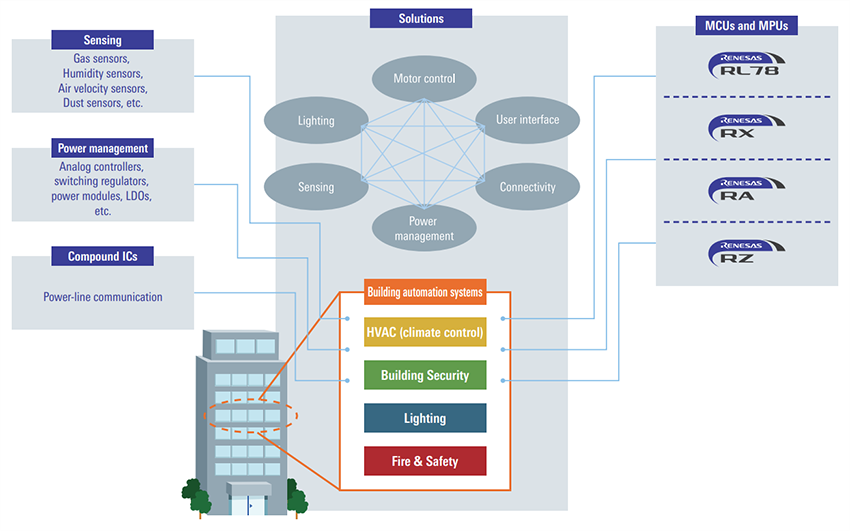

Sensors in the Building Environment

There are a variety of sensors at various locations throughout the interior of a typical building. The sensors utilized in building automation include Temperature/Humidity sensors, Air Quality (Gas) sensors, Air Velocity sensors, and integrated sensor modules. These sensors offer superior sensitivity and accuracy.
HVAC Systems

HVAC building automation systems can be divided into two types: central air conditioning and individual air conditioning. In a central air conditioning system, a heat source in a single location is used to circulate air, water, or steam to the various rooms, and exchange heat, to cool or heat each room to the specified temperature. In an individual air conditioning system refrigerant gas is circulated and exchanges heat. Regardless of the type of air conditioning system, generally speaking, the various units are connected to a wired or wireless network to facilitate control and state management. In the context of building automation in particular, BACnet is used to connect HVAC devices from different manufacturers and
configure the building management system.
Fire and Safety Systems
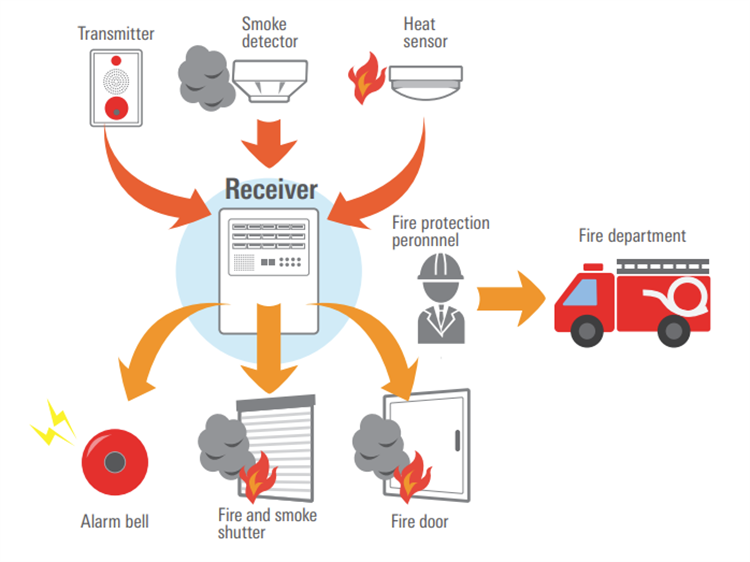
In the context of building automation, fire and safety systems are designed to detect the outbreak of fires and provide warning. An automatic fire alarm system for buildings has a receiver that detects when one of the sensors connected by wires is triggered by a fire. The system then alerts the building occupants by sounding alarm bells or voice alarms throughout the building. Fire alarms used in buildings and homes employ the same sensing methods, but they differ in that building systems are connected to networks while home systems are independent and sound the alarm individually.
Building Security Systems
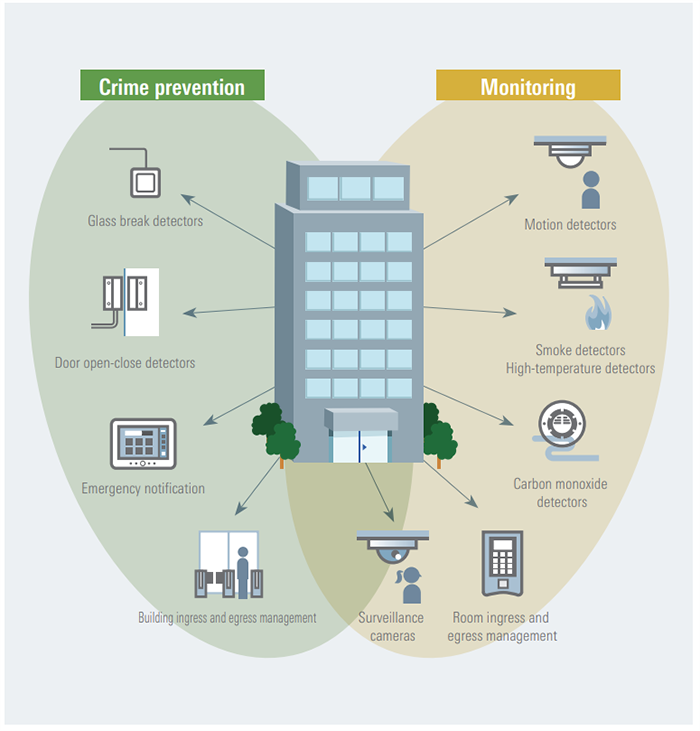
A security system is composed of two constituent elements. The first is a monitoring system that oversees what is going on in and around the building utilizing cameras and sensors of various types. The second is a crime prevention system that performs ingress and egress management and control based on the information from the monitoring systems.
Lighting Systems
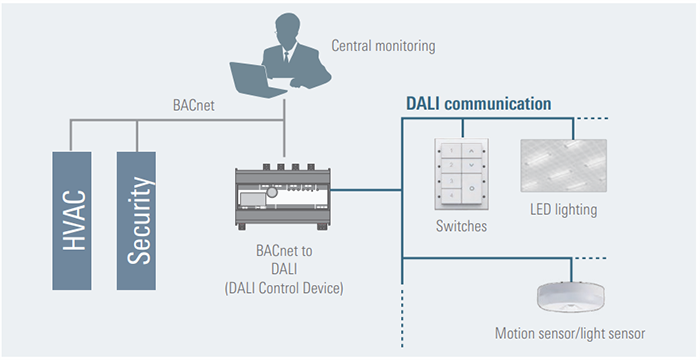
Increased demand for building lighting with reduced installation/operating costs as well as energy efficiency, low maintenance, and attractiveness (the ability to adjust the brightness and color of the light) attract tenants and users. The keys to achieving these requirements are network support, task/ambient lighting, brightness/color adjustment, and digitization. One building management network standard that is gaining worldwide adoption is the BACnet communication protocol. BACnet supports integrated management of building automation systems for air conditioning, lighting, crime prevention, disaster prevention, and more. In addition, it makes it possible to reduce the energy consumption of the building overall.
The DALI international communication standard for lighting is specified in IEC 62386. Communication takes place between a master (control device) and slaves (control gear). The DALI standard supports a single control device, which can control up to 64 items of control gear. The DALI-2 standard is currently coming into use. DALI-2 defines emerging applications, adds new functions, and improves compatibility to better meet the lighting requirements of customers. Also, a device must pass an official test to receive certification of compliance with the standard.
Related Products

Renesas Electronics RA0E1微控制器
採用Arm® Cortex®-M23內核,具有低功耗和最佳化的周邊裝置。
Renesas / Dialog DA14531 SmartBond TINY™ System-on-Chip
Ultra-low power SoC integrates a 2.4GHz transceiver and an ARM® CortexM0+™ microcontroller.