




CML Micro EV6550DHAT Raspberry Pi HAT
CML Micro EV6550DHAT Raspberry Pi HAT combines the Raspberry Pi and the CMX655D Ultra-Low Power Voice Codec conveniently and inexpensively. The combination enables the easy demonstration of the CMX655D and provides improved low-power audio capabilities to the Raspberry Pi. This is achieved using common hardware and open-source software, creating a platform that is easy to use and simplifies product development.
A Raspberry Pi HAT (Hardware Attached on Top) is an add-on board that mounts directly onto the GPIO header of a Raspberry Pi B+ Single Board Computer (SBC). The EV6550DHAT conforms to this standard and integrates the functionality of the CMX655D Ultra-low Power Voice Codec into the Raspberry Pi environment.
The EV6550DHAT enables the CMX655D Voice Codec's feature set (two matched channels supporting a wide variety of digital MEMS microphones, signal processing, and a 1W high-efficiency Class D speaker amplifier) to be easily demonstrated. Control and demonstration of the CMX655D are handled via a Graphic User Interface (GUI) that is pre-loaded into the EEPROM. The GUI allows for the recording of audio files at 8ksps, 16ksps, 32ksps, or 48ksps, with adjustment of input audio gain from -12dB to +3dB. Control of playback volume can be adjusted from -90dB to 0dB, and muting and smoothing are also available. Four pre-recorded samples can be played at different rates to compare sample rate and audio quality.
Features
- Small, compact design conforms to Raspberry Pi HAT standards
- Wide range of open-source compatible software available
- 2x top-ported digital MEMS mics
- Easy screw connection for external speaker
- Flexibility to use local or off-board power for the amplifier
- Accessible GPIO and test pads to allow further options, such as external mics
- User-modifiable prototype space
- Option to add a line out phono connector
- Simple GUI with open-sourced drivers
- On-board reset button or reset via the GUI
Applications
- Demonstrates CMX655D functionality
- Product development with the Raspberry Pi
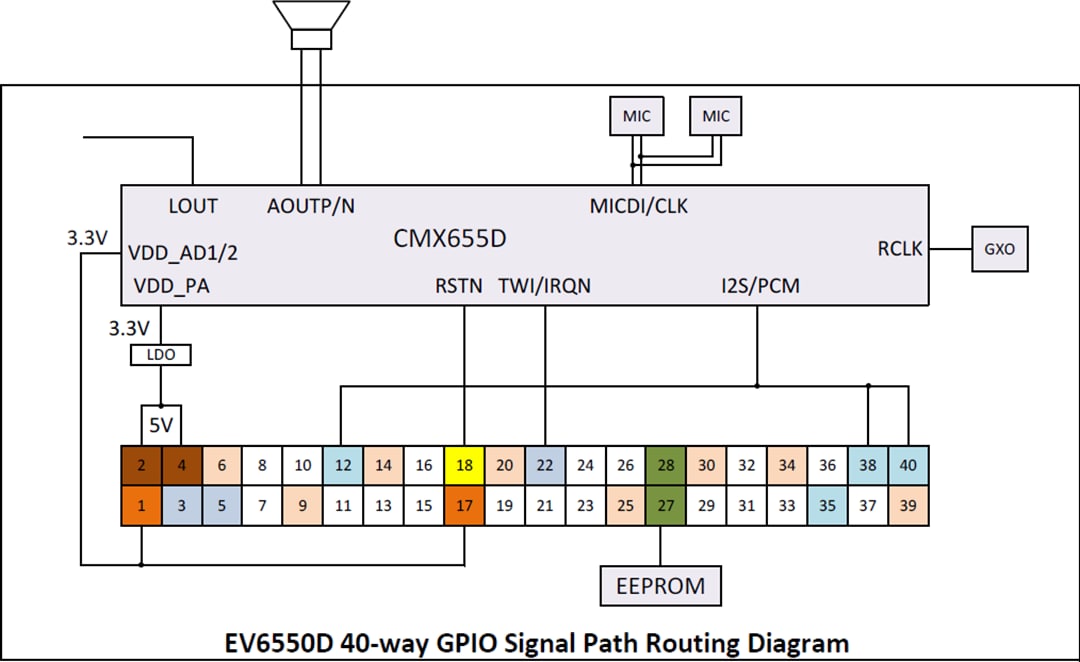
GPIO Signal Path
Related Codec
CML Micro CMX655D Ultra-Low Power Voice Codec
Flexible, low-power codec with an integrated MEMS microphone interface and class-D speaker driver.